Civic Engagement & Policymaking Toolkit
Imagine. . .

Your institution’s halls filled with diverse community members learning how they can volunteer their time to clean up the local environment, help neighbors access nutritional food, or share accurate information on critical public health issues.
Local policymakers recognizing your institution as a trusted source of scientific and community information they can rely on to inform their decisions and actions.


Visitors feeling more connected to issues they care about and empowered to act, alongside their fellow community members, to bring about better solutions.
Community members turning to your institution as a partner in taking action on local socio-scientific issues.

This toolkit serves as a guide for science centers and museums and other science engagement organizations to thoughtfully identify and implement ways to nurture civic experiences like these across their work or deepen ongoing civic initiatives for meaningful change within their communities. Within this toolkit, we use “science engagement organizations” to refer to a wide range of institutions, including:

Science-focused informal learning institutions, such as science centers, natural history museums, zoos, aquaria, arboretums, botanical gardens, nature centers, and planetariums.

Other museums and cultural centers, such as history museums, historic houses and sites, specialized museums, children's museums, and public libraries.

Science organizations and scientific societies, such as the Union of Concerned Scientists, American Geophysical Union, National Science Policy Network, and Association for Advancing Participatory Sciences.
Whether you are new to civic engagement and policy-related work, or have some experience, this toolkit provides a roadmap to navigate numerous available resources and tools produced by both civic engagement and science engagement organizations. We also define roles science centers, museums, and other science engagement organizations can play in community-centered collaborations that inform civic activity and policymaking. It also offers inspiring examples of ambitious civic engagement projects and provides guidance on adding civic components to your existing exhibits and programs.
Key Toolkit Definitions
These activities can include dialogue, volunteering, or involvement with government or another sector, and can occur at varying scales whether it be individual, collective, local, or global. Civic engagement increases the capacity and agency of all interested parties to address pressing issues and future challenges and opportunities. Civic engagement goals can include democratizing knowledge and decision making or engaging more people in public issues to ensure outcomes—like new laws and ordinances—reflect community priorities.
Informed by community priorities, strengths, and leadership, community science offers a wide range of Approaches, including dialogue, data collection, and civic engagement, that address injustices, reduce disparities, and help achieve equity. See ASTC’s Community Science Framework to learn more about the diverse models and Approaches to community science that are currently in use.
For example, a company’s paid leave allotment, a nonprofit board’s term limits, city zoning ordinances, and the U.S. Endangered Species Act are various types of policies.
While policymaking is often associated with government, it can apply to all types of institutions, including business, research, and non-profit institutions and decision-making groups like regional transportation planning councils and independent school boards.
What You’ll Find in This Toolkit
This toolkit outlines a Community Science Approach, Civic Engagement & Policymaking, where science and technology are factors in collective civic action and policy decisions to meet community goals. It includes:
- Guidance for your team on how to get started with this work,
- An overview of what Civic Engagement & Policymaking as a Community Science Approach can entail,
- Descriptions of four roles your organization can play to authentically engage with communities on civic priorities,
- Examples of real collaborations between science engagement organizations and their partners that advance community priorities,
- Tools, guides, and other resources to help you prepare for new civic engagement efforts and/or expand or deepen existing civic engagement efforts.
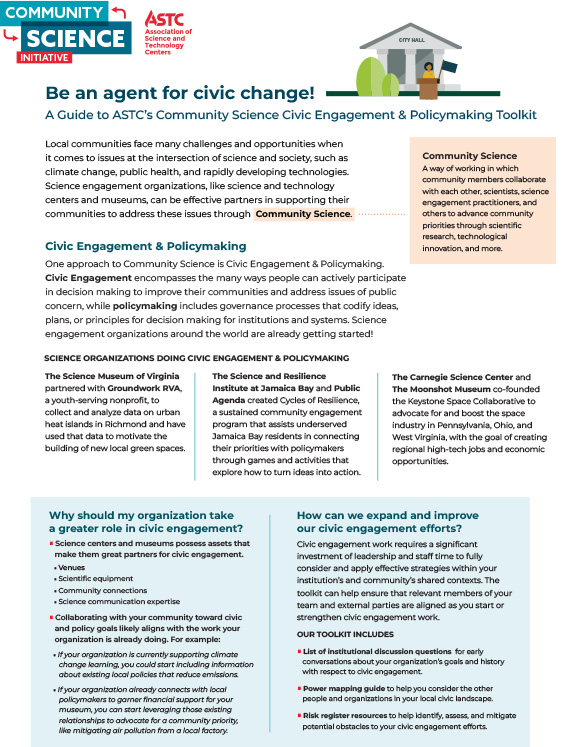
Read the Toolkit Summary
Download a concise overview of this toolkit’s key insights, strategies, and actionable steps to help you effectively collaborate with your community on civic and policy efforts.
Now, let’s go!
Dispelling Myths about Civic Engagement
Learn about why this work may be a good fit for you and your organization.
About This Community Science Approach
Learn more about Civic Engagement & Policymaking, how it can advance community priorities, and why your organization can be an effective civic partner.
Critical Preparations
Review discussion questions and tools to help you prepare for a new civic engagement effort.
Glossary
Get to know key definitions related to Civic Engagement & Policymaking.