Science centers and museums can be dynamic spaces where communities converge, ideas intermingle, and conversations evolve. Embarking on civic engagement efforts can help science centers and museums move beyond their core roles as educators and learning facilitators to create settings that reflect and respond to the diverse voices and changing needs of their communities. This toolkit aims to guide your organization to find a role which leverages your organization’s strengths to authentically engage with local communities, build lasting connections, and drive positive civic change. In some cases, a museum may lead the charge and help organize partners around a common goal, while in other cases the museum may uplift, promote, and supplement existing work of community members. It will take careful consideration of your institution’s strengths and goals, as well as a thorough understanding of the communities you seek to engage, to find the right role(s) for your organization.
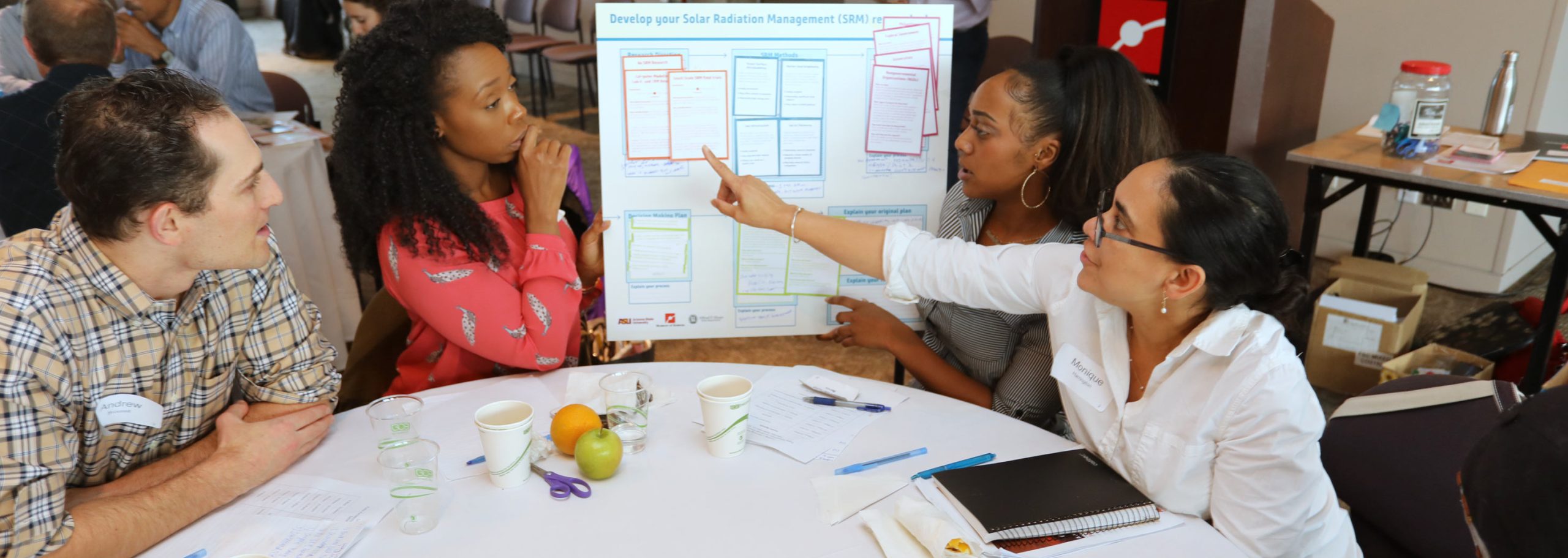
The Museum of Science, Boston hosted public deliberation forums to discuss the benefits and drawbacks of emerging technologies.
Preparing Your Institution for Civic Engagement
Before jumping into civic engagement activities, it is important to first carefully consider your institution’s strengths, goals, and what would constitute success. It’s also critical to build a thorough understanding of the communities you seek to engage to find the right role(s) for your organization. You may find the questions in ASTC’s Getting Started in Community Science Discussion Guide helpful as you assess your institution’s readiness and identify goals, as it provides questions to help you develop an equitable community partnership.
There is some natural tension between defining your goals internally and co-creating them with community partners. If you do not define any institutional goals from the start, you risk working on something that runs counter to your values and strategy. On the other hand, overly specific and rigid goals could discourage others from working with you and may not effectively address community priorities. Here are some questions you may want to consider with your team before beginning a civic engagement effort:
- What is your institution’s motivation for starting, increasing, or deepening civic engagement work?
- Are your organization’s leaders in alignment on pursuing civic engagement efforts?
- What are the major constraints on your civic engagement work (e.g., risk aversion among leadership, lack of resources, and staff training)?
- What conditions or guardrails does your institution need to put into place before beginning civic engagement work?
- Does your organization have a plan for dealing with potential negative attention or controversy?
- What is your institution’s history with civic engagement and policymaking? What were the outcomes of your past efforts (if any)?
- What is your institution’s relationship with local communities? Are there exploratory conversations that need to happen prior to embarking on this initiative?
- What relationships does your institution have with local civic actors (e.g., policymakers, elected officials, community organizers, local advocacy organizations, and activists)?
- What is your ability and intention to sustain engagement and collaborative partnerships in the long term?
- What is missing from current civic discourse or policy processes on local issues at the intersection of science and society? Is your institution positioned to add value and, if so, how and where?
- What issue would you like to help address in your community? What are potential ways this issue could be addressed? Are there any solutions that are unacceptable to your institution?
- Are you aware of any controversy surrounding the issue and is your institution prepared for how to communicate, engage, or respond in ways that align with your mission, vision, and values?

Choosing Community Partners
Communities bring unique and essential perspectives and expertise from diverse lived experiences which, if included in decision making, can help develop ethical, equitable solutions to pressing science- and technology-related challenges. ASTC defines “communities” as connected or organized groups of people who share a common geography, jurisdiction, set of characteristics, interests, or goals—not just a particular racial or ethnic group or zip code. We encourage those seeking to engage in community science to be specific about which communities they aim to partner with and serve in order to find collaborative partner(s) that authentically represent those communities’ priorities. You may need to work with multiple partners to adequately represent the diversity within your community and gain specific skill sets, perspectives, assets, or networks. It is important to keep in mind that no single organization can fully represent a community. Consider developing a broad coalition of partners that bring diverse perspectives to the table. See “Contributing to Coalitions” for additional considerations and resources on this topic.
A community partner is a public or private organization, entity, or group that represents the community, provides community services, and centers community needs, priorities, and/or goals. Some examples that may fit this definition include community development nonprofits, faith-based organizations, neighborhood civic associations, environmental advocacy organizations, youth-focused nonprofits, membership organizations, Tribal governments or organizations, libraries, cultural organizations, social clubs, parent-teacher associations, and regional planning commissions. Community Science requires collaborative work and often seeks to address current and historical harms within a community, so the ideal community partners may be very different from the organizations with whom you have historically partnered. When working with communities that have not historically partnered with science engagement organizations or experience systemic oppression, building mutual trust and reciprocal relationships is a necessary first step before jumping to project collaboration. It is key that partners have confidence that your institution will center their interests and not further exploit them.
- Learn more about critically examining your institution’s history: Creating a Framework for Institutional Genealogy from Incluseum describes a framework for deeply investigating institutional legacies and making connections between the past, present, and future of an organization.
- Learn about fostering authentic and equitable partnerships: Authentic & Equitable Partnerships from Funders for Reproductive Equity contains a framework for building lasting partnerships that can form the foundation of a movement.
- Learn about best practices for collaboration: Scientist-Community Partnerships: A Scientist’s Guide to Successful Collaboration from the Union of Concerned Scientists (UCS) explores the benefits of scientist-community partnerships, ways to navigate relationship building, common challenges in local community involvement, and more.
Consider Partners’ Strengths
Every community partner will bring unique assets and strengths to the table. For example, an issue-focused nonprofit may have a deeper understanding of a topic’s scientific background but may be less connected to the community than a neighborhood association. Authentic partnership goes beyond including an organization whose resources you would like to use or that can offer complementary scientific expertise. Look for partners who are authentically connected to and committed to centering the interests and needs of the people you hope will benefit from your work, who will listen with humility when the community offers their insights and perspectives, and who will uplift community knowledge and lived experiences. This form of engagement requires all partners to not privilege their scientific expertise or knowledge over community members’ lived experiences and expertise.
- Learn about honoring community strengths: Asset-Based Community Development: Shifting Museum’s Center of Gravity by the American Alliance of Museums is a blog post exploring various frameworks and tools to help museums authentically share leadership with their communities.
- Learn about different opportunities for youth civic engagement: Youth Engagement Continuum from Organizing Engagement is a model for deepening engagement with youth by prioritizing youth development and leadership, and supporting youth in building skills, capacity, and collective identity as social change agents.
The Museum of Life and Science in Durham, NC facilitated workshops exploring solutions to extreme heat events.
Consider Histories of Oppression and Marginalization
It is particularly important for science centers and museums to work with community organizations because scientific organizations have—and often continue to—perpetuate existing unjust hierarchies. Regardless of intention, a science engagement organization’s work can interfere with progress toward some community members’ priorities. So-called “scientific evidence,” for instance, has been used to prop up white supremacy, patriarchy, transphobia, racism, sexism, and other systems of oppression. In other circumstances, technological advancements can create unforeseen negative consequences. For example, while new technologies like AI hold promise in many ways, they could also eliminate or change the nature of some jobs. It is also important to note that many communities have embraced and wielded new technologies to meet their needs, and that no community is a monolith.
While science engagement organizations are, in many cases, working to both reveal and disrupt these systems, they remain a part of their legacy. Museum professionals may be eager to jump into civic engagement work and feel they already know what needs to be done to address a particular community issue. However, no matter how much knowledge the museum holds, it is essential to work with the broader community to truly understand the issue and create the desired impact, rather than assuming you fully understand the issue and know the right solution. This type of assumption can lead to further harm, degraded community trust, and unintended negative impacts. Instead, by working authentically with communities, you can use the often-privileged status of your organization to support and uplift groups systematically barred from resources or that experience increased risks when they advocate for their community.
- Learn about environmental justice principles: Learn About Environmental Justice from the Environmental Protection Agency (EPA) discusses the definitions, executive orders, laws, and statutes related to environmental justice in the United States.
- Learn about issues at the intersection of technology and race: Disrupting the Gospel of Tech Solutionism to Build Tech Justice by Greta Byrum and Ruha Benjamin is an exploration of the ways that modern technological advancements continue to uphold racist systems.
Consider Potential Harms
- Learn about risk-informed planning for collaborative processes: Risk-Informed Development Guide from the Global Network of Civil Society Organisations for Disaster Reduction is a resource that provides practical advice on the process of risk-informed development planning to strengthen the capacity of civil society organizations to engage with communities most at risk.
- Learn more about proactively assessing community risks: Understanding Risk and Protective Factors from Community Tool Box is a chapter about working effectively to address community issues by reducing risk factors and enhancing protective factors.
Ciencia Puerto Rico equips locals with culturally relevant resources to respond to the COVID-19 pandemic and future challenges.
Tips for Initial Outreach to Potential Partners
Seasoned community science practitioners say these are the best ways to begin partnerships on a positive, equitable note:
Don’t come empty handed
Show your seriousness and intention to equitably partner by offering your time, resources, and carefully considered plans on how you can contribute to mutual goals. For example, you may want to invite partners to discuss potential collaborations over a meal that your institution pays for.
Respect people’s time, effort, and expertise
Don’t ask for more time or effort than is needed, recognizing that most people and organizations have limited resources and many competing priorities. If you’re not likely to use or consider what you are asking partners to contribute, then you likely don’t need to ask for it.
Don’t assume other organizations will want to work with you
While your institution likely has expertise and resources that can help potential partners meet their goals, they may have had previous experiences that make them hesitant to work with museums, other science engagement organizations, or researchers. Potential partners may also have limited financial and/or human capital and little capacity to take on new work.
- Learn some brief tips and tricks about collaboration: Strengthening Your Impact through Collaboration from the Union of Concerned Scientists (UCS).
The Importance of Power Mapping
Before embarking on any civic engagement journey, we encourage you to engage in a power mapping exercise. Power mapping is a process that identifies and analyzes relationships among key community members and decision makers within a community. This can help identify individuals and organizations that have influence over your desired outcomes, and whether they support or oppose your specific goals. Engaging in this exercise can help make explicit the formal and informal, recognized and unrecognized sources of power that may shape your civic engagement efforts. This nuanced understanding of the social and political landscape can enable you to make informed decisions about engagement strategies and partnerships, increasing the likelihood of success in addressing community needs. Identifying power dynamics also allows science engagement organizations to approach community collaborations with an awareness of potential imbalances, helping identify who needs to be centered in service of equity, justice, and inclusivity. Power mapping should be revisited throughout a project’s lifespan to ensure you are incorporating new learnings and adapting your strategy over time.
Below is an example of a power map outlining different fictional players under consideration for a project focused on reducing lead in a city. The map shows who may be powerful allies in achieving the project goals, and who may oppose this hypothetical work.

Power mapping is an essential first step in understanding the landscape of existing civic engagement to decide whether and how your organization would like to engage on this topic. Explore the resources below to consider how you can best conduct your own power mapping.
- Learn about different sources of power: Sources of Power from the National Community Development Institute is a list of different types of power that an individual or organization may have, with brief tips about how to minimize power differences when working in a group.
- Learn about how to conduct power mapping:
- Power Mapping Your Way to Success from the Union of Concerned Scientists (UCS) discusses why and how you should create a power map and offers several different types.
- Power Mapping and Analysis from The Commons Social Change Library is a step-by-step approach about when to conduct power mapping, who to involve, and how to use your power map to strategize next steps.
Terms for Community Members
As you work on initial power mapping, you may run into an array of terms used to describe individuals or groups that hold power within communities:
At the broadest level, interested parties are people or groups that may have a stake in a matter but lack direct decision-making authority. There are likely to be various types of interested parties.
Stakeholders are typically individuals or groups with an interest in a particular issue, or who may be impacted by a decision, but may not necessarily hold inherent rights or claims. Note: In some contexts, the word “stakeholder” is associated with the history of colonization. Due to this connotation, consider replacing it with a more affirming and accurate term. Appropriate alternatives for your context might include collaborator, participant, interested/affected/relevant party, or partner.
Rightsholders are those who possess legal entitlements, such as voting rights, land tenure, or protections from discrimination.
Decision makers are individuals or entities with the authority to make choices that can impact the course of civic initiatives. Decision makers are people in positions of power to introduce, deliberate, and enact socially impactful decisions. Decision makers are not always or necessarily elected officials; they may also include municipal department heads, political appointees, and non-elected officials.
Creating a Risk Register
Alongside mapping key dynamics and relationships, it is vital to consider potential risks and challenges your organization may face. A “risk register” is a strategic tool that helps identify, assess, and mitigate potential obstacles. Putting this tool into practice involves analyzing factors that could impede success, from external resistance to internal resource constraints. Risk registers and power mapping are interconnected elements of strategic planning. Power mapping helps identify interested parties and their influence, including those who may challenge your initiative. Identifying the individuals or groups who may oppose your collective goals is a crucial element of a risk register and considering them will help you anticipate potential conflicts or obstacles. You can then return to your power map to identify those who can support you in overcoming these obstacles, and proactively develop strategies to navigate challenges and build more resilient and effective civic engagement initiatives.
In addition to considering risks that might impede your success, it’s necessary to consider how your success may introduce unintended consequences. For example, when conducting climate hazard assessments, updated flood risk maps you create may be used by insurance companies to increase flood insurance costs or reduce home values, exposing communities to financial risk.
- Learn about how to create a risk register:
- Risk Register Template from the University of California Office of the President is an Excel template for conducting a risk register, complete with an introduction and instructions on how to use it.
- Risk Register and Manual from National Disability Services (Australia) is a library of resources developed to help organizations implement systems and processes to drive positive outcomes for people with disabilities.