

Our world faces a multitude of complex challenges at the intersection of science and society, from public health and climate change to AI and digital literacy.
In the last decade, the Association of Science and Technology Centers (ASTC), science centers, museums, and the broader science engagement field have been part of an ongoing conversation marking the need to engage communities, not just as learners or visitors, but as co-creators of science for the public good.
The opportunity is clear: People want science to serve their real-life questions and priorities—and they want to be involved. But the next steps are murky: What does this kind of public engagement look like in practice? And what role can science centers and museums play?
Community Science is an umbrella term that ASTC and others apply to a wide range of engagement approaches—from community-driven citizen science to participatory policy-making—that position community members as leaders and leverage science as a tool for the public good. ASTC’s Community Science Initiative has developed a wealth of tools to support this work, including a Framework, a Getting Started Guide, and a Resource Library. Additionally, ASTC has provided direct funding to individuals and organizations advancing Community Science work, most recently through the Cultivating Community Science Stipend (CCSS) program.
The CCSS Program: Putting Community Science Into Practice
The 18-month CCSS program, completed in late 2025, supported four teams—each consisting of an ASTC-member museum and a local partner organization—to carry out collaborative projects aligned with ASTC’s Community Science Framework.
ASTC’s Community Science Framework

Each project employed one or more Community Science approaches, or program models, identified in the Framework. Each was designed and grounded in core Community Science attributes, which shaped the project’s goals and the way partners worked together. And, each of the four projects identified and evaluated one or more target outcomes related to science, society, and the public good.
Significantly, Community Science is not a singular method, but a constellation of possible community engagement practices. Here, it can be helpful to think of community engagement as a spectrum. On one end of the spectrum lie top-down approaches where institutions simply deliver science-related information and services to the community. On the other end of the spectrum are approaches and practices that engage community members as experts, decision-makers, co-developers, and disseminators of those scientific goods.
Both the Framework and the CCSS program were designed to help ASTC member institutions imagine and implement progressively more collaborative and community-driven practices, within their unique contexts.
Below, we highlight and celebrate three CCSS projects, along with the ASTC members and community partners who collaborated and learned along the way. While the projects vary significantly in topic, approach, and setting, they all tangibly demonstrate what Community Science approaches, attributes, and outcomes can look like in practice. For each, we provide a project description and highlight significant outcomes. Finally, we conclude with some cross-cutting takeaways, useful for anyone hoping to initiate or deepen community-centered science engagement work.
Chequamegon Northwoods Food Coalition – Cable, Wisconsin
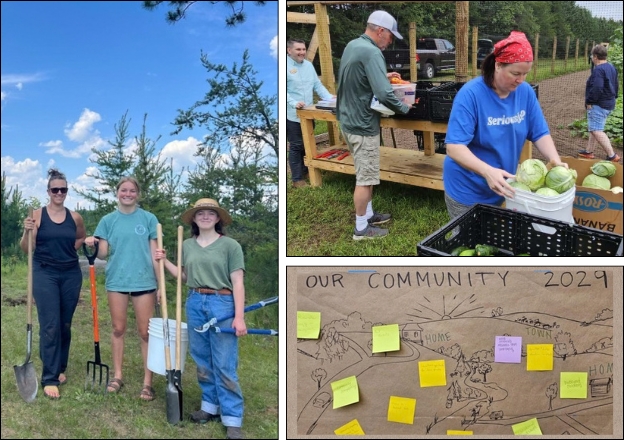
Team: Cable Natural History Museum (CNHM) and Cable Community Farm (CCF)
Approach: Civic engagement
In the context of Community Science, civic engagement encompasses a broad range of activities that enable collective action or decision-making related to a socio-scientific issue.
Project Description
For the rural, agricultural communities of the Wisconsin Northwoods, food security is a significant concern, made worse by climate change, isolated farmers, and the conflicting interests of agricultural and forestry industries. In response to these challenges, CNHM, CCF, and the community members they live and work with saw an opportunity to support both their local economy and household food security by sharing agricultural knowledge, farming practices, and solutions, by creating the Chequamegon Northwoods Food Coalition.
At its core, a coalition is an organized group of people invested and collectively participating in a shared cause. To build this foundation, the project team focused first on outreach—hosting community listening sessions to shape an understanding of community needs and build a compelling message, and then taking that message all over the three-county region through both formal events and informal interactions with community members. These efforts helped solidify a centralized leadership council for the Coalition.
One of the Coalition’s first projects was to launch an incubator micro-grant program. Early in the process, community buy-in was so strong that the council was offered supplemental donations to distribute funding to all applicants. In total, 13 awardees received a collective $10,000, using funds for emergent local needs related to agricultural resilience.
Project Insights and Outcomes

Sustainable Solutions for Society. Incubator grants, though small, had a tangible effect on the local food system. Community members used grants to fund timely and innovative investments that would otherwise have been unavailable. They purchased plants, seeds, and other farming supplies; acquired new tools or equipment; and developed educational programming. As one grantee explained: “With our new watering system, we were able to streamline our watering schedule. We also increased production of fresh produce, which allowed us to sell our goods to local markets.”

Capacity for Civic Engagement. Though staff from CNHM and CCF played a critical role in launching the Coalition, they also worked proactively to shift leadership away from their home institutions by creating a community-led Leadership Council, which will eventually drive the work of the Coalition and further develop local capacity for civic engagement.
CNHM noted that, through Community Science, they were able to expand not only their impact, but their identity and role in the community as a natural history museum.
“We can really reflect on what’s our capacity to be a community catalyst and a community builder… [beyond just] visitors and collections. I really love how this has been an expansion of what we can provide as a resource… that the organization is part of the community, part of all of these needs... So, being a natural history museum does not mean that we are separate from other experiences of our community.” — Cable Natural History Museum team member
Food for Thought – Warrenton, North Carolina
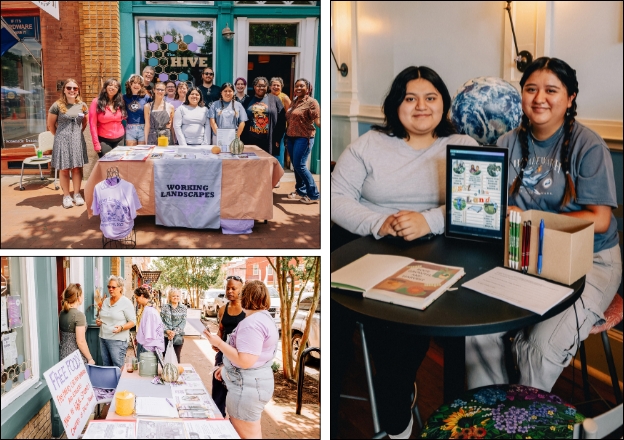
Team: Museum of Life and Science (MLS) and Working Landscapes (WL)
Approach: Participatory research
Participatory research is a method of inquiry in which community members shape the research questions, data collection, analyses methods, and dissemination of results.
Project Description
Across the United States, another rural community saw an opportunity to promote agricultural and economic resilience through Community Science. Warren County, North Carolina is an agricultural region about 60 miles outside of Durham. In the 1980s, Warren County residents mobilized to oppose toxic waste disposal in Black communities—an effort often credited as launching the broader environmental justice movement. Today, Warren County faces challenges familiar to many rural, agricultural communities, including environmental degradation, food insecurity, and limited economic opportunity, particularly for youth.
The Museum of Life and Science (MLS), a Durham-based natural history museum, and Working Landscapes, a Warren County-based nonprofit committed to strengthening the local food economy, came together with the goal of addressing these present-day challenges. The project, “Food for Thought,” leveraged Working Landscapes’ unique relationship with food and Warren County, and the Museum of Life and Science’s expertise in youth programming.
Together, staff from the two organizations co-designed and implemented a youth-led, participatory research project addressing the broad question: What is the future of food in Warren County? Over the course of nine months, local youth participated in place-based learning and skill development workshops while developing their own research projects exploring aspects of Warren County’s food system. Youth then presented their research findings to fellow residents at the community’s annual Bluebird Festival, through interactive posters, presentations, and activities. Youth-led projects aimed to help the county better understand its agricultural assets and opportunities for the future.
Project Insights and Outcomes
The Food for Thought project was driven by the underlying need to understand and promote agricultural and economic resilience in Warren County. Though it’s hard to measure the impact of this project against that broad and ambitious goal, the project did see near-term outcomes aligned with the Community Science Framework.

Increased Science Agency. In addition to simply learning about agricultural science, youth who participated in Food For Thought became more confident in their ability to practice science. Surveyed youth reported increased confidence in the use of various research methods, as well as their ability to communicate about science with others.

Strong Community Partnerships. Throughout the project, staff from MLS were excited to partner with North Carolina communities beyond the urban core the museum typically serves. At the same time, they were trepidatious about coming into a rural community and inadvertently steamrolling that community’s own strengths, history, and culture. In this regard, Working Landscapes was a key partner, thanks to their deep knowledge and relational capital in Warren County. The two organizations collaborated with intentionality, developing working norms to share leadership and develop trust, to serve not only the present project but anticipated future projects as well.
As one project team member put it:
“We have put in a lot of work in making sure that this is not purely a professional relationship or one that only exists within the confines of a grant… It is about the people and the fact that we have… these shared goals… and that we have a desire to continue to work together. And the result is this really relationship-driven, reciprocal relationship, rather than one that’s purely transactional.”
Yolsentlalpixkeh Indigenous Youth Research Council
– Los Angeles, CA

Team: Gabrielino-Shoshone Nation of Southern California, Anawakalmekak International University Preparatory of North America, (Anawakalmekak), Tzicatl Community Development Corporation (Tzicatl CDC), Natural History Museum of Los Angeles County (NHMLAC)
Approach: community-driven participatory research
Participatory research is a method of inquiry in which community members shape the research questions, data collection, analyses methods, and dissemination of results. This example of community-driven participatory research centered Indigenous science, youth, and intergenerational learning.
Project Description
The Los Angeles region is the ancestral land of numerous Indigenous Nations whose stewardship of ecological systems was disrupted by colonization. In 2023 the Gabrielino-Shoshone Nation of Southern California rematriated 12 acres of land, in partnership with Anawakalmekak International University Preparatory of North America, a public charter school rooted in Indigenous education and science, and Tzicatl Community Development Corporation, a nonprofit organization that advances indigenous rights, ecosystem restoration, and community land stewardship. The land, named Chief Ya’anna Vera Rocha Regenerative Learning Village in honor of Sky Chief Ya’anna Vera Rocha, presented an opportunity to model urban, Indigenous-led environmental resilience while empowering youth as place-based Indigenous scientists and stewards. They established the Yolsentlalpixkeh Indigenous Youth Research Council to guide and partake in research, stewardship, and development of the site.
The Natural History Museum of Los Angeles County came into this project as a partner with institutional resources and expertise to support youth-led ecological research. Over two years, the Yolsentlalpixkeh youth conducted holistic baseline research, using iNaturalist, within Ya’anna Village. Their research focused on five areas: water retention, soil remediation, terrestrial ecology, land accessibility, and wildlife conservation. Throughout this work, youth were guided by a community coalition of Indigenous scientists, Native educators, culture bearers, a native Nawatl linguist, community-based subject-matter experts, Indigenous students, and the NHMLA community science team.
Youth shared their research findings with the community at multiple Youth Summits. Additionally, youth developed a quadra-lingual (Gabrielino-Shoshone, Nawatl, Spanish, English) field guide that would complement and connect the public with the ongoing field research at Ya’anna Village, while incorporating Gabrielino-Shoshone and Nawa epistemology and phenology and highlighting Ya’anna Village’s role in the community.
Project Insights and Outcomes

Impactful scientific research. This research, which establishes baseline ecological conditions at Y’anna Village, has an immediate applicability for the Gabrielino Shoshone Nation’s ongoing stewardship of the site.
Increased Science Agency. Participating youth reported being more confident in their ability to conduct research using multiple sources and methods; collaborate with indigenous peers, mentors, and experts; and conduct their own observations through fieldwork. They also developed skills at analyzing and interpreting data and communicating findings, including strategies to make science more accessible to the public. Importantly, in terms of scientific agency, youth felt empowered in both Indigenous and Western ways of thinking and practice.
One Yolsentlalpixkeh youth council member described how the program strengthened their science agency, from both Indigenous and Western scientific traditions.
“I think the idea of connecting the Western science with Indigenous knowledge and teachings [came up] when we were doing the [field guide] pages. That… taught me a lot about how I could connect these two things.”
Cross-cutting themes and lessons
The three projects highlighted above are different in many ways; by definition, each was designed to respond to a specific community’s needs.
For the CCSS program, ASTC partnered with an evaluation firm that worked closely with each team to develop tools and metrics for understanding the impact of their projects on a local level (see full Evaluation Report). Here, we gather high-level themes—seen across all three projects—that can inform future Community Science efforts.
Ample time is required to build strong, equitable partnerships. All three project teams invested significant time nurturing relationships between partner organizations and with members of the community they serve. For anyone new to Community Science, this emphasis on relationships before deliverables may feel tediously slow; however, in the context of Community Science, strong, trusting relationships are a prerequisite for meaningful work.
Shared leadership requires intentionality and trust. Equitable collaborations don’t happen by accident; they are built, through intentional conversations and systems, with a healthy dose of humility. This is particularly true for projects where one or more project partners outsizes the other in terms of power, prestige, and/or resources.
Success requires matching scope to resources—and flexibility. All three projects were designed in response to big, complex issues, from climate change to Indigenous sovereignty. All three project teams identified ambitious goals to address community priorities around these issues. And, over the course of the 18-month CCSS program, all three project teams adapted their plans in response to real-life circumstances, timelines, and resources. For example, the Chequamegon Northwoods Food Coalition de-prioritized one long-term goal (developing a digital hub) in order to prioritize a more achievable near-term goal (launching the incubator grant program). The Los Angeles team leading the Yolsentlalpixkeh Youth Council adjusted their timeline and priorities following the devastating 2025 Southern California Wildfires. Far from failure, these adaptations are evidence of teams responding to community priorities.
Community Science is not a program, a method, or a checklist, but a way of working. Our hope is that these examples, as well as the extensive resources developed by ASTC’s Community Science Initiative, inspire science centers and museums to find more ways to incorporate collaborative, community-centered practices into everything they do.
Explore more
Learn more about Community Science and the Cultivating Community Science Stipend (CCSS) program. Contact us at communityscience@astc.org.

Explore resources—including a Framework, Getting Started Guide, and project examples—from ASTC’s Community Science Initiative.

Read the full evaluation report for the Cultivating Community Science Stipends program.

Learn more about these and related projects in the open-access article in Citizen Science: Theory and Practice
The post Cultivating Community Science: Lessons from Three Museum-Community Partnerships appeared first on Association of Science and Technology Centers.